Tagged: pope benedict

Haise Wedding Speech: We Rejoice That You Exist!

It’s been over seven months, but I’ve been meaning to post a few things from my wedding last summer. I’ll start by sharing my more formal remarks from the reception. This part of the speech begins just after the toast to the bridesmaids and ends just before Heather joined me for the thank yous.

In Joseph Conrad’s Heart of Darkness, the main character, Marlow, spends the majority of the novel sharing a story with his fellow passengers on the deck of a ship on the river Thames. He relates this story in such a vivid and compelling way… but at one point, he trails off, overwhelmed at the impossibility of truly sharing the inner depths of his experience with another person outside of himself.

“It seems to me I am trying to tell you a dream — making a vain attempt, because no relation of a dream can convey the dream-sensation, that… absurdity, surprise, and bewilderment in a tremor of struggling revolt, that motion of being captured by the incredible which is of the very essence of dreams. . . .”

He was silent for a while.

“. . . No, it is impossible; it is impossible to convey the life-sensation of any given epoch of one’s existence, — that which makes its truth, its meaning — its subtle and penetrating essence. It is impossible. We live, as we dream — alone. . . .”

“We live as we dream — alone.” Since I first encountered that line, it has never left me. Marlow said what I would have said, had it been possible for me to set my scattered thoughts in order. In those five words — we live as we dream — Marlow encapsulates that which is most profoundly agonizing about this life: our inability to share it totally with another.

Don’t we all long for unity in the depths of our hearts? Marlow was left to despair, because he thought it was impossible. And it may not be fully possible in this life… but there are some things in which we can find glimmers of that original unity which we all long to reclaim.

“The principal difference between someone dreaming and someone awake,” Pope Benedict said this past Christmas Eve, “is that the dreamer is in a world of his own. His ‘self’ is locked into this dreamworld that is his alone and does not connect him with others. To wake up means to leave that private world of one’s own and to enter the common reality.” It is “the truth that alone can unite all people.”

What is truth?

I strongly believe it is this: that “man… cannot fully find himself except through a sincere gift of self.” (Gaudium Et Spes 24) It is in giving ourselves that we can find ourselves, that we can tear down those walls and bridge the gap between us. It is through gift that we find unity, find common union, find communion.

And what is love, but the ultimate gift of self?

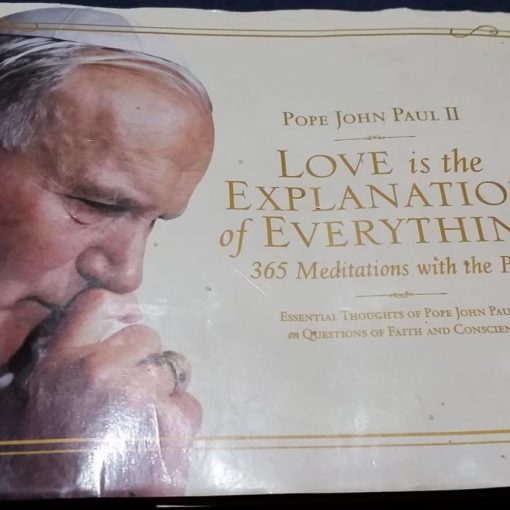
“Love is not merely a feeling,” says JPII. “It is an act of the will that consists of preferring [constantly] the good of others to the good of oneself.”

And while I’m quoting popes, Benedict XVI (then Cardinal Ratzinger) wrote:

If an individual is to accept himself, someone must say to him: ‘It is good that you exist’ – must say it, not with words, but with that act of the entire being that we call love.

* * *

You are all here tonight because Heather and I love you, and because you have loved us. You have celebrated with us, you have comforted us. You have shared in our burdens and our joy, in our great triumphs and in our epic fails. You’ve put up with us, and you’ve stood up for us. You’ve given us life. You’ve showed us patience and kindness, and forgiven us when we may have been impatient or unkind in return. You’ve been there to laugh with us. Some of you have grown up with us, some of you have been grown-ups to us, and you’ve all grown on us a great deal. You’ve helped to shape Heather and I into the people we are today. You are our friends, our family — our community. You have given us so much: You have taught us how to love.

I’ve been told that this is our “special day.” I suppose it is… but this isn’t a celebration of couplehood; it’s a celebration of family. Whether through blood or other bonds, thank you for being our family. Thank you for showing us love, for showing us how to love, for giving of yourselves and for sharing your lives with us.

It is good that you exist.

* * *

So… we live as we dream, longing for unity… but the truth, that is love, can set us free. What does any of this have to do with marriage?

To get back to quoting popes… John Paul II wrote that “in this entire world, there is not a more perfect, more complete image of God, unity and community, than marriage. There is no other human reality which corresponds more, humanly speaking, to that divine mystery…” to that ultimate unity of three persons in one.

Marriage, I firmly believe, is a tiiiiny foreshadowing of that ultimate unity, a tiny glimpse of what it could mean to not live as we dream, but to be united; a tiny taste of Heaven… I know Heather and I will have hard times ahead. I hear the four stages of marriage are honeymoon, disillusionment, misery, and then — if you’re lucky — joy. (Heather’s asked if we could skip the middle two.) A mentor of mine always says of marriage that we shouldn’t hang our hat on a hook that can’t bear the weight. Heather, I know that I will disappoint you at times, that I will fail to love you perfectly, as you deserve, but I pray that you will remain united with me in this thought: it is your love, Heather, that shows me ultimately what it is to be loved; it is your love that leads me to the love that satisfies, as we journey together towards ultimate communion.

In the words suggested by St. John Chrysostom for such a moment: Heather, I have taken you in my arms, and I love you, and I prefer you, Heather, to my life itself. For the present life is nothing, and my most ardent dream is to spend it with you in such a way that we may be assured of not being separated in the life reserved for us. . . . I place your love above all things, and nothing would be more bitter or painful to me than to be of a different mind than you.

* * *

This day has been a long time coming, but it’s always felt like another big event. I don’t have any understanding yet how big it actually is. Preparing the apartment, it was a bit unreal to think that it would be home in a matter of weeks. It felt more like going to Australia in 2008 — new and exciting, but ultimately a short-term adventure. Or, preparing for this day felt kind of like preparing for a big concert at Hart House, even for the proposal — in the aftermath of these big events, things return mostly to normal… but this, this is a new normal. Weddings itself are pretty new to us. Lisa summed it up as she was planning Heather’s bachelorette, and said, “I’m fully planning this party based on Google searches.”

So, we wouldn’t be here today without your love and support to bring us here. We rejoice that you exist!

Creative Commons Attribution-Share Alike 2.5 Canada Permalink | Comments (1)

Pope Benedict XVI Defends World Youth Day

Pope Benedict XVI defends World Youth Day, head on:

Benedict laid out the traditional critique of World Youth Day – one that he knows well a few of his own lieutenants are, at times, inclined to share.

“What, therefore, is the nature of what happens at World Youth Day?” the pope asked rhetorically. “What are the forces which run through it? Fashionable analyses tend to consider these days as a variant of modern youth culture, as a kind of rock festival with the pope as the star. With or without faith, these festivals would be more or less the same thing, and in this way the question of God can be taken off the table. There are also Catholic voices that cut in this direction, seeing the whole thing as a big show, perhaps attractive, but ultimately of little significance for the question of faith and the presence of the Gospel in our time. By that account, these would be moments of joyful ecstasy, but at the end of the day they leave everything as it was before, without influencing one’s life in a deep way.”

Benedict then proceeded to take the critique apart.

He also defends the Christian concern for the environment. [original article]

Creative Commons Attribution-Share Alike 2.5 Canada Permalink | Post a Comment

The New York Times: A Papal Discussion

The New York Times used to be an example of what not to do online, but they really cleaned up their act last year. Aside from dropping the pay-wall and diving head first into the open source community, they launched a ton of great blogs.

With Pope Benedict XVI’s visit to the United States around the corner, Thomas Peters (the American Papist) recommended an excellent blog called “A Papal Discussion,” which “examines the role of Pope Benedict XVI in modern Catholicism.” It boasts a variety of qualified contributors from different backgrounds and faiths.

Today, Alejandro Bermudez wrote a great post in anticipation of the Pope’s message, outlining three key aspects to watch for:

  1. The Pope will restate Church teaching (i.e. Pope still Catholic!) on “controversial” issues.
  2. The Pope is not caught up in political correctness; he “is a creative, independent thinker, and he is more used to intellectual honesty than to crowd-pleasing.”
  3. The most important parts of his message will likely not be sound bites which are easily quotable on the news. The are two proposed keys to interpretation:
    1. “Pope Benedict is convinced that Catholic theology needs to engage in an honest discussion with modernity”.
    2. Benedict believes that faith and reason are not opposed, but in fact important allies against the “postmodern belief that truths worthy of being transmitted down the generations don’t exist.”

Alejandro’s point that the most important part of the message won’t be “cotton candy” is a credit to the blog itself; while the New York Times would have trouble covering the message in depth through traditional mass media means (i.e. a newspaper), the blog allows the New Times to facilitate exactly this sort of coverage by leveraging the power of digital technology and the Internet.

Creative Commons Attribution-Share Alike 2.5 Canada Permalink | Post a Comment
Creative Commons Attribution-ShareAlike 2.5 Canada
This work by Blaise Alleyne is licensed under a Creative Commons Attribution-ShareAlike 2.5 Canada.